Monday, March 4, 2019

The Future of Food: A Systems Approach to Global Agriculture 2.0


‘ You say it’s a living, we all gotta eat*….’
The Problem
When we look across the spectrum of technological and societal endeavors which are connected to both the largest challenges facing humanity, as well as to some of the largest potential commercial opportunities, we need not look any further than the (dining) table. Food and fiber are simply the cornerstone of society, from local to global scale. Perhaps lyricist/poet Robert Hunter* said it best — we all do need to eat. At the most foundational level, if the business and technology worlds are going to attempt to sustain a healthy planet, a healthy population and a healthy global economy, the complimentary initiatives should be placed on fostering a systems approach towards agriculture, as it literally touches every one of us.
Meeting the nutritional needs of a growing population that is on pace to reach 10 billion by 2050 will not be easy. Fragility of supply chains, emerging diseases, weather disruptions, contagion risk, lack of water in key origins…these are only a handful of the many challenges facing the global agricultural value chain, and it is important to note here that the discussion should not be solely one of food security. Taking a systems approach, what we really should be striving towards is the concept of nutrition security. As my former Mars colleague Howard Shapiro has very successfully emphasized and communicated over the years, many of the calories that feed the world today are simply empty calories; caloric intake with no nutritional benefit. If we are attempt to talk about food security in the 21st century seriously, the dialogue must shift to embrace the holistic concept of nutrition systems security.
Expanding on this idea a little further, it follows that large scale centralized agriculture, which leads to regional monoculture, simply does not work over time. Despite the best efforts from the food production/processing, biotechnology and chemical industries, diminishing crop biodiversity via traditional monoculture in the long run promotes development of agricultural disease, depletion of soil nutrients and productivity capacity, stress on water tables (particularly where deep-rooted varieties are dominant) and systemic crop risk, as well as the inhibition of food choices. Each of these topics will be addressed in greater depth in future papers, but it is worth stating that a systems approach applied to how food is selected, grown, processed and distributed will not only promote agricultural biodiversity and market participation, but it will also enhance nutritional and quite possibly societal security.
Over the last two decades, I have worked closely with just about every sector across the agricultural value chain. This diverse group includes suppliers, producers, traders, consumer goods corps, co-ops, distributors, breeders, chemical manufacturers, and many others. It is extremely difficult, if not nearly impossible, to name another sector with reach across as many sub-sectors as the food and beverage complex. Global agriculture, perhaps more than any other operating sector, is a complicated and complex business and as a result, no problems can be tackled nor can solutions be generated via traditional discipline-specific silos. For Global Ag to work, and to evolve to meet societal needs of the coming decades, it must adopt a decentralized approach built upon a systems foundation.
Systems Agriculture: Technology Considerations
(Image courtesy of MIT Media Lab OpenAG)
In recent years, the food industry has witnessed a rise in technology companies that are looking to the laboratory for new ways to assist in feeding the planet, while at the same time minimizing environmental impact. This is a reaction to what can be traced to both supply and demand side pressures in global agriculture. To take one example, synthetic biology has made great progress in R&D, potentially bringing to market commercially viable substitute protein products which satisfy the demands of the carnivore, minus the ethical, environmental and economic externalities commonly associated with traditional livestock production. Another example with potential upside can be seen in the burgeoning indoor or controlled-environment agriculture sector. Here we have also seen a rise in supply-side activity, both in the traditional the startup community, as well as in the corporate venture space. These and the many other ‘alternative agriculture’ tools and technologies are most certainly welcome pieces to the puzzle, and I feel that they will have a growing place in the portfolio of tools needed to address Agri decentralization. However, at least in the short term, in aggregate, the suite of new market entrants will still occupy a niche with respect to the global industrial agriculture stage.
Most of what we consume has been and will continue to be derived through relatively traditional plant and animal harvesting, via means which have not changed all that much since agricultural and livestock domestication, some of which date back to the transition into the Holocene. Simplistically, seeds are planted, and this is followed by watering, nourishing, harvesting, in some cases processing, and ultimately their products are consumed. Similarly, while livestock husbandry has been effectively industrialized and scaled, the general series of events associated with the lifecycle of protein harvesting has not changed very much. So while I expect all of the new players in the Food2.0 world to contribute a steadily increasing percentage of global food and nutrition requirements, most of the world’s efforts will continue to improve upon what we perceive as traditional agricultural practices. When it comes to food and agriculture, society is still largely at the mercy of Mother Nature. Drought tolerant varieties and developments in field applications notwithstanding, to put it simply, if it doesn’t rain there is no grain.
Systems Agriculture Solutions: Physical Resource Theory
(Image courtesy of Chalmers University)
For all of the reasons mentioned above, viewing global agriculture through the lens of complex systems is not only preferable, but actually necessary if we are to realistically assess the risks, opportunities, and potential developments that come to mind as we address the growing challenges associated with global nutrition security. This ensemble of variables encompasses all of the components across the entire agricultural value chain, comprised of dozens upon dozens of industries where the physical and life sciences are so tightly coupled with global commerce. As a result of the complex nature of global food, the application of Physical Resource Theory (PRT) as a means to assess what can be grown, at what rates, under what environmental conditions, and above all with commercially and socioeconomically equitable outcomes, is an appropriate platform on which to build a tangible transition to Food2.0.
Sustainable application of PRT as it is applied to global food production is predicated upon the understanding of both biophysical energy transfer from source to (edible) product, as well as capital transfer between supplier, producer and consumer. The biophysics and economics of resource production can not be divorced from one another, although many of the more traditional agricultural ‘models’ tend to just focus on only one half of the problem. A complex systems/PRT framework more effectively weaves together considerations related to crop potential and market potential through a series of stocks, flows, transformations and transactions, and will ultimately lead to more robust planning and sustainable solutions. When we analyze global agriculture, we can do so in the same manner that the biologist examines the behavior of the cell. Observation reveals a collection of processes dealing with energetics, transfer, competition and cooperation, each agent performing a function that spills over and affects their neighbor, and somehow all of this machinery comes together to result in a functioning cell embedded within a larger operating system. So by definition and going to the roots of complexity science, the cell as a whole IS more than the sum of its parts, and the emergent behaviors that have evolved allow the larger scale systems to perform efficiently. Taking the industrial biological metaphor from micro to macro, the same concepts can be constructed into a ‘model’ that can guide the evolution of systematic benefits to global agriculture. Competition is of course encouraged, but this can and should be balanced with cooperation incentives as a means to ‘open-source’ benefits to the larger system. We have seen this approach work in software, genomics, computational and data sciences, and it is starting to take hold in energy and transportation. Agriculture should be next.
Driven by economics, the waste from one industry becomes the feedstock for another. Diversity leads to not only system strength, but also system resilience. This interplay among agents actually becomes an indirect form of systemic risk management in the face of disruptions where the catalyst could be climate, disease, geopolitics, sanctions, or any number of other external forces. To be clear, all of this does in fact occur to some degree, but a more comprehensive and concentrated effort among market ‘agents’ is needed for systemic PRT to scale.
To extend the Chalmers University PRT definition and framework to the global agricultural complex, effective implementation and maximum potential system benefit will reside at the decentralized intersection of technology, society, nature, commerce and culture. The favorable transition from physical/biophysical/economic theory to practice will result in a higher quality of life for consumers (nutrition security), sustainable business models for market agents (commercial security), and biosystem resilience and productivity (natural security).
Additional technical papers addressing the ideas presented here will follow.
— — — — — — — — — — — —
At Atlas Research Innovations, we look to the network sciences, geospatial analysis and the evolution of technologies for guidance and risk management in the new economy. Along with our network partners we will be publishing articles related to the global commodity trade, applied science and technology, and the manufacturing complex, while embedding principles and developments which promote Industrial Ecology integration across the agriculture, energy and materials complex.
For more information, please contact:
Michael Ferrari, PhD
Managing Partner, Atlas Research Innovations

(this article was originally published on Medium)

Investing in the Anthropocene

Geography, Environment, and Systems Sustainability

The elusive search for favorable and uncorrelated returns across asset classes has pushed investors in recent years into the space of alternative data, with the hopes of discovering new, untapped sources of information that can be acquired, analyzed and transformed into a sustainable market advantage. This occurs in financial services through the trader’s ongoing quest for new sources of alpha, as well as in the private equity/venture capital arena, where investors are looking for differentiated and scalable ideas that will become the companies of tomorrow. In either case, new data is accompanied by new investable themes, and one theme which has been gaining in popularity falls under the Environmental, Social & Governance, or ESG, umbrella. ESG has been around in some fashion for decades, but to date it has been more marketing than substance. Further, upon closer examination of what comprises most ESG efforts, we see that it carries very little true meaning as it relates to financial performance or to true environmentally responsible investing. Therefore, it is time to rebrand ‘ESG’ as ‘GESS’ and with this will come an approach towards investing with a more technical and global purview: the updated GESS should focus on investable themes that complement one another to connect companies, natural and industrial ecosystems, and markets under the moniker of Geography, Environment, and Systems Sustainability.


The rise of ESG themes, as well as the funds marketing these themes to prospective clients, highlights the need to explore investable ideas that demonstrate a return while also providing a hedge against corrupt business practices. However, when we look closer at how these measures are generated and quantified, many of today’s ESG scores are largely assigned based on factors related to softer criteria. Some of these include the strength of the leadership team, higher-level emissions data released through disclosures, public perception, number of fines/citations, supplier certifications, etc. The majority of these are subjective measures, or they are benchmarked against a baseline with little meaning. In any case, they also do not assess how a company operates within the larger system of multi-continental industries, where regulatory measures span many jurisdictions. In contrast, a truly meaningful GESS strategy grounded in actual (physical, chemical, ecological) data related to industrial output proxies can uncover a more representative suite of characteristics related to how sectors and companies perform, how they can be scored, and ultimately how they rank. For the purposes of building a new definition of strategies that benefit both economy and environment, a framework for the ESG to GESS transformation should contain the following elements:

Geography: Rather than focusing on single companies and their upstream suppliers, fundamental analysts should develop a read on the operations of a company as examined through a global geographic lens. As supply chains have become global, single-country origins are not as meaningful as they once were; supplier networks become more important than country of origin. This new geography also takes into account both social and physical characteristics of commerce, including trade routes and partners, biogeochemical and climatic cycles impacting raw material sourcing, foreign exchange exposures and geopolitical implications of trade, resource use and cooperation.

Environment: How do we define the true environmental performance of a company? How do they lead in environmental performance with respect their operating sector? Today, ESG analysis looks at 5–10 year plans, and how companies improve against in-house benchmarks. This tends to become arbitrary at best, sandbagging at worst. Looking at an accurate and representative environmental footprint of a company requires not only assessing progressive changes in emissions reductions which are linear, but also step changes in efficiency technology adaptation around managing waste, raw material spend, and use of alternatives, all of which carry exponential benefits.

Systems: Pulling from the complexity sciences, a systems approach looks at agents within a system and examines how they operate in concert with one another, how they evolve, and how new properties emerge. Taking this application to the examination of industrial ecosystems, a holistic systems approach will look at how agents within a sector influence behavior of cohorts, emergent inter and intra-sector properties, and the impact of incentives and disruptors. This approach also lends itself to borrowing algorithms from the evolutionary sciences, leading to new tools for examining systemic risk, something sorely needed in traditional ESG analysis.

Sustainability: G+E+S=S. A revamped measure of sustainability, therefore, is a synthesis of the three components described above. Sustainable investments, and the businesses that they represent, will take all three of these components into account, and this also will allow for a unique view when attempting to compare companies in different sectors — something that proves to be quite difficult under current ESG methodology.

As the GESS framework evolves, the information and insights generated will serve as raw material for both fundamental and quantitative investors. This should in turn increase both the depth and breadth of the data and methods that will be used to assess environmental and economic potential and performance. In addition, we should see a demand catalyst for technology/data transfer, as Universities, National Laboratories, and startups germinated in academia are searching for more avenues to apply research and technology findings. Hopefully, the data-as-a-service model will stimulate incentives for all types of scientific data, typically not the domain of investors.

Future articles will take a deeper look at specific examples where scientific data coupled with a systems approach can generate insights regarding micro and macro behavior as it relates to firms, sectors and economies. This should be of interest to investors, analysts and possibly most importantly, risk managers.


Feel free to contact Atlas Research Innovations to learn more.

(this article was originally published on Medium)

Sustainability, STEM, and the International Day of Women and Girls in Science

STEM in 2019
Today (Feb 11) should be on the calendar for a few reasons. We recognize National Inventor’s Day, (not to be confused with Inventor’s Day) celebrating contributions from the likes of the Wright Brothers, Thomas Edison, Hedy Lamar, Nikola Tesla, and George Washington Carver, among others. This date also happens to be the birthday of Edison. But February 11 is also recognized globally as the International Day of Women and Girls in Science (IDWGS). Science and technology move fast, with the gap between idea and application becoming ever shorter. Understanding how science and technology are shaping our lives, and more importantly, appreciating the risks involved with their application, is particularly important in 2019. Therefore, commercial sector science should take advantage of the IDWGS as a platform to close the Science Technology, Engineering & Mathematics (STEM) gender gap for several reasons.
First, 2019’s theme is “Investment in Women and Girls in Science for Inclusive Green Growth.” The need to develop pathways to stimulate global economic growth grounded in science, which are equally distributed when viewed measured with both economic and environmental objectives, needs no further discussion.
Second, the total number of PhDs earned by women in the US were once again greater than the number earned by men in 2017* with many fields being split relatively evenly. However, in the STEM fields of Engineering, Physical Science and Mathematics/Computer Science, conferred degrees are still heavily skewed male. To be clear, I do not view a PhD as a gatekeeper to a career in science; this is just one data point to support the larger statement. We don’t need commissioned reports to confirm this. Think of the last scientific or technical conference you attended. What was the gender distribution, both in terms of speakers and attendees? If a conference panel was not specifically marketed under the banner of ‘Increasing Diversity’, what was the percentage of female participants?
Third, nearly all aspects of modern life are increasingly predicated on advances in science and technology, and the speed at which this transition has taken place over the last two decades is nothing short of astounding. AI. CRISPR. GPS. Commercially viable EV. NewSpace. VR/AR. The list goes on. What is clear is that the research and development of tools, methods and technologies which were the subject of uncountable PhD theses not long ago are now, literally, embedded into commerce, retail, energy, food, transportation healthcare and more; the lines between the laboratory and society have become blurred. Understanding how these pervasive technologies function, break, repair and evenly distribute will require a more scientifically literate public. What’s more, what once passed for science fiction is now part of the fabric of society. Managing risk without both (a) a deeper understanding of how technology development and transfer works, and (b) an appreciation of possible risks, is, as Carl Sagan so eloquently stated, a recipe for disaster.
Finally, there is a growing sentiment that even many scientists do not really understand science very well. Simplistic replication of studies and misuse of statistics are both commonplace. Following the scientific method should illuminate more about what we don’t know, rather than confirm what is accepted. Risk management, therefore, is then embedded into the thought process when designing an experiment. I think the commercial sector gets this. When decentralized experimentation is fully embraced and distributed systems are fostered, good things happen.
Creating the Future
‘The best way to predict the future is to create it’. Some attribute this quote to Abraham Lincoln (who incidentally shares a birthday tomorrow with Charles Darwin). Others claim it came from Peter Drucker. Regardless of the statement’s origin, when we look at the scientific, societal and economic challenges facing a world with 7.7 billion inhabitants, the current importance of this statement can not be understated. It should also be noted that science is not a zero-sum game. Inclusive science, particularly with a commercial origin, has the opportunity to engage and serve everyone. Commercial opportunities in STEM are also inherently interdisciplinary, particularly appealing to those who are intrigued by figuring out how the world works from a variety of perspectives. It is now common to see evolutionary science underpinning theories in finance, physics-derived applications in biology (and vice versa), and computer science driving advances in geospatial sciences. With advances in computational resources, sharing of data and methods, and open-sourced technology, ‘science’ can start to be viewed as a verb, as opposed to an occupation. As such, as a society we cannot afford to limit our technological potential by not making STEM opportunities available and attractive for half of the world’s population. Further, the effort to encourage more females to take up STEM careers is not just for traditional students. Refer to IBM’s successful STEM Re-Entry program (which I helped pilot and have written about before) to see how mid-career professionals can transition to careers in science and technology, regardless of their formal educational training.
Science is hard. It is also time consuming. And there are no shortcuts. Real science is also quantitative, so equally important to your scientific field(s) of interest, is the ability to represent ideas and support them numerically, extracting signal from noise. This is precisely why the STEM fields are so engaging, and ripe with opportunity. Whatever your interest is, looking at the world through the STEM lens can provide a path to tackle an infinite number of problems, and the prospect of turning your passion into a career has never been higher, serving the world in the process.
With the evolving global economic, environmental and geopolitical landscape officially placing us in the age of the Anthropocene, it is as important as it ever to recognize the contributions of female scientists, engineers, inventors and entrepreneurs, and provide opportunities for more to follow. As I (frequently) resort to one of the many yellow-paged Carl Sagan books on my shelf for inspiration, I feel that he put it best, and we are wise to heed his words.
“We’ve arranged a global civilization in which most crucial elements profoundly depend on science and technology. We have also arranged things so that almost no one understands science and technology. This is a prescription for disaster. We might get away with it for a while, but sooner or later this combustible mixture of ignorance and power is going to blow up in our faces.”
― Carl Sagan, The Demon-Haunted World: Science as a Candle in the Dark
The choice is ours.
- — — — — — — — — — — — — — — — — — — — — — — — — — -
*Women were awarded more PhDs in the US than men last year, WEF link.
For more information, please contact:
Michael Ferrari, PhD
Managing Partner, Atlas Research Innovations

(this article was originally published on Medium)

Brazil Sugar under Bolsonaro


Outside of ever-present weather pressures, the world sugar market should be paying close attention to the BRL/USD relationship. Aside from a brief dip and recovery at the start of the year, ICE Sugar futures have been generally rangebound since Nov18, trading between 12.5 & 13.25 cents/lb. Most technicals are running neutral, and with market consolidation expected to continue, there is no immediate threat of an upside catalyst until we get a little closer to the expiration of the March contract. Therefore, it is important to look at FX movement in major origin countries, emphasizing Brazil.
Sugar futures softened for much of 2018 and not all of this slide was driven by supply-side concerns. The behavior of sugar futures largely mirrored the weakening of the Brazilian real over the course of 2018, and if we extend a forward view of the currency situation, this could be a leading indicator for directional moves in commodity front month contracts. The real has been showing some signs of strength in recent weeks, but still not at the levels seen 1 year ago. If the real continues to strengthen vs. the USD, we look to two potential supporting scenarios:
  • Macro: Continued real strength (and dollar weakness) will support agricultural commodity prices in general, and will specifically be a constructive factor to world (#11) sugar
  • Micro: A stronger real will also support an operational scenario which has a tendency to lead to higher output costs for Brazilian growers and millers, exacerbating the constructive price environment.
So with approximately six weeks until March contract expiration, even without supply side scenarios, we are looking at more upside risk.
The ethanol conundrum
Enter ethanol. With Brazil’s new President Jair Bolsonaro’s support, biofuels will likely see a much more prominent role in the sugar/energy complex in 2019. First, WTI Crude is currently in the low $50/barrel (today’s close at 52.24), and if we assume that the primary benchmark is off of its’ 1-year low, a constructive crude market will make cane derived ethanol more attractive, in turn strengthening demand. For Brazilian cane, as the sugar/ethanol split starts to skew towards fuel, cane sugar will see supply-side limitations, supporting prices for Mar/May ICE sugar futures. Further, Bolsonaro vowed during the 2018 campaign to help Brazil return to the #1 position in global ethanol production. Whether or not Brazil surpasses the United States in production is not as important as the realization that a concerted effort to do so will divert sugarcane away from consumption balance sheets, strengthening the #11 futures market price in the process.
Continue to visit this site for ongoing discussions pertaining the physical, technological and market components associated with the global commodity complex.
Disclosure: At the time of this writing, I own no ETF/ETN products related to sugar, ethanol, or derived products. At the time of this writing, I do own shares in ADM, which carries a material risk to price movements in agricultural commodities, including corn, sugar and soybeans.

Data.Space 2019. What Lies Ahead?


The Data.Space 2019 conference ended on Friday, and it was great to get to meet, listen to and talk with some of the players in the burgeoning UK Space sector. The two day event covered a lot of ground and there are a few takeaways that I feel are worth sharing. Fortunately my talk came on the second day of the conference, so I did have an opportunity to address these three points from both buy side and sell side perspectives.
1. There still seems to be a disconnect between solution providers and clients, and this is concerning.
2. Technology development and adaptation to address #1 continues to level the playing field for market entrants. Barriers to entry are lower for small companies to compete.

3. The investment climate should be monitored.
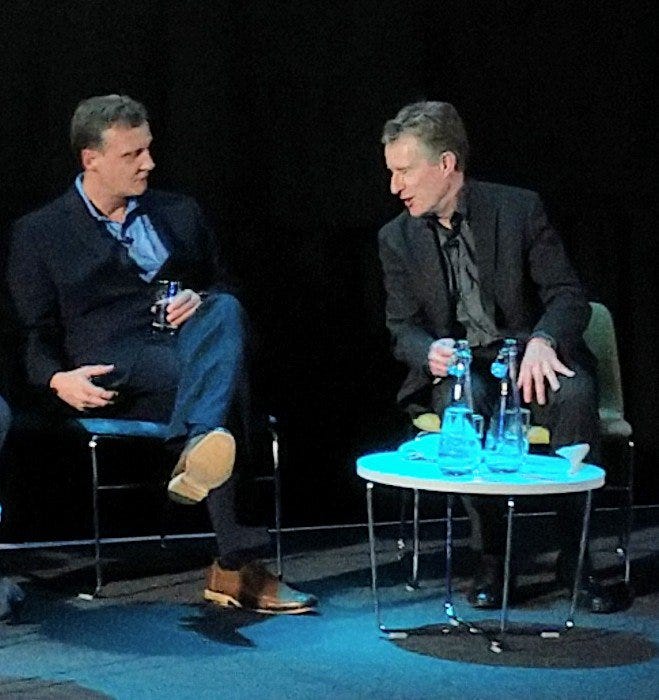
(discussion during the Challenges.Space session)
Recent startup success in the space sector (Planet being the most visible) has served as a great catalyst for shifting the perception of those following the space sector from expensive science experiment to viable commercial business. However, there is still work to do, particularly on the side of the solution providers. Having the dual vantage point as both a provider (sell-side) and consumer (buy-side) in the alternative data space, I believe that data-driven space startups still need to make a clear and tighter business case for their services, which are now fashionably marketed under the ‘as-a-service’ moniker: Space Data as a Service. Yes we are seeing an increase in launches, with more platforms collecting more data, and that data is being transformed into more services, supporting more industries, etc. But the customer still needs to see a clear path to revenue, and in many cases that message is not still being translated effectively.
This problem is not unique to the NewSpace sector — it is actually a broader Data as a Service problem. In financial services, the rise of the ‘quantamental investor’ has spurred demand for all sorts of non-traditional data, which machine learning and data scientists then exploit to try to generate a market advantage. This alternative data ranges from credit card transactions and geolocation data, to weather and satellite data. But generating insights from this data is usually much more challenging than it sounds. The sell side are the experts in the data itself (how it is collected, what it represents, domain-specific nuances associated, etc) and this knowledge is oftentimes difficult to translate to potential clients. Further, they are not always well versed enough in how a FinServ/FinTech client may want to use the data. On the buy side, users want to utilize the data towards identifying trade opportunities, but they usually are not well versed in the intricacies and nuances associated with the data they are ingesting. This disconnect can lead to confusion, false expectations, and frustrations on both sides. One way to avoid this confusion is to build teams that have some real expertise from the other side of the table. If you are a satellite data provider selling to Financial Services, get a former trader on your staff. People looking into the financial services sector from the outside, with no direct experience, usually have a very different idea of how the buy side operates, what they do with data post acquisition, and most importantly how to monetize.

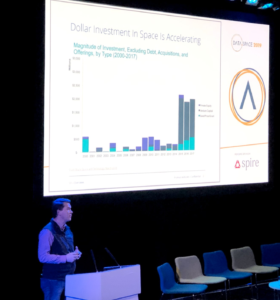
Dr. Gareth Keane of Promus Ventures

On the investment side, I would have liked to hear a little more from the VC/PE community. We all know that NewSpace is generating buzz amongst VC investors, and sector deals have jumped dramatically since 2015 (even without the Planet raises). But there was one slide which really stuck out from Gareth Keane’s (of Promus Ventures) talk. As Dr. Keane was discussing investment in the sector since 2000, I couldn’t help but to think of the cleanTech boom (and subsequent bust) from a decade ago. In 2008, the market was generally rangebound, then saw a huge inflow of capital from just about everyone, the market got frothy, and this was followed by a bust. Today, CleanTech is growing in a much more sustainable manner, but there were some very expensive lessons in 2008. Some of the same factors are in play today: similar macroeconomic factors, impatient investors, longer timelines, and market uncertainty. Certain driving forces are beyond our control. But we should look to the 2008 cycle to avoid some of the behaviors that contributed to the market withdrawal. Prudent investing, including proper diligence, technical understanding, and can help the NewSpace sector avoid some of the traps that led to the CleanTech exodus.
This is the last post from Data.Space2019; my first two posts can be found here and here. While there are challenges ahead, the NewSpace community is talented, committed, and possibly most importantly, global. I am absolutely optimistic on the potential of NewSpace, globally, in 2019, and I look forward to Data.Space2020.
If you are interested in receiving the slides from my presentation, please follow this link, or contact me at michael@atlasresearchinnovations.com.

(this article was originally published on Medium)

Alternative Data in Agriculture Risk

As noted in the Atlas Research Innovations teleconnections and food security papers, global agricultural risks are numerous in cause and effect, and geographic exposure is growing. Further, these risks are complex in the sense that they may have one or several unique catalysts. When all is said and done, every human on the planet needs to eat, so it is no overestimation when we discuss food security in terms of a global issue. Identifying potential supply-side risks and implementing appropriate responses, both physical and financial, will require a new lens through which to view risk to markets, trade and society at a foundational level.
Therefore, a more complete understanding of the global commodity supply chain is needed if we are to anticipate and manage risks to the world’s food supply. This Atlas Research Innovations paper discusses the framework around an alternative method to view agriculture risk: Alternative data in Agricultural Risk Management (AARM). Most risk managers employ somewhat traditional methods when trying to speculate stocks and flows of supply, and associated price movements. As such, most are also using the same data for their analyses and projections, and if there is a supply event that is not considered ‘normal’, they cannot assess potential market reactions ahead of time. We advocate for the use of a different set of tools. The identification and quantification of raw material exposures by commodity sector using non-traditional data and analysis allows for early signal detection towards identifying potential opportunities and managing risk related to agricultural commodity market activity.
The AARM strategy was developed as a means to manage physical commodity risk and the related market impact through (a) alternative data exploitation and (b) the employment of alternative methodologies. Standard risk management techniques are not sufficient to monitor and anticipate for commodity volatility, and this precipitated the development of the AARM strategy. The AARM strategy has been evolving since 2001, and continues to improve as new data and methods become available.
Contact us at Atlas Research Innovations to receive a copy of the technical paper, and to learn more about how your organization can take advantage of the next wave in physical and financial commodity risk management.

(this article was originally posted on Medium)

Agriculture’s Origins


The foundation of global commerce is the supply chain, consisting primarily of agriculture (food & fiber), material and energy. Feeding and providing energy to 7+billion people will continue to be one of society’s most significant challenges, and developing a new risk management framework around potential disruptions to the supply chain is becoming increasingly important with each passing year. This is particularly true when we view risks against the backdrop of a growing and more affluent population, changing demographics and buying preferences, and physical disruptions with natural and man-made causes. In a recent Atlas Research Innovations technical paper, I demonstrated how the utilization of global physical teleconnection analysis can aid in identifying and managing risk across the global agricultural supply chain. Early identification of potential threats may not prevent the disruption from occurring, but it certainly may allow us to better prepare for the effects across sectors and geographies. Teleconnection analysis is just one tool of many scenario-specific measures which highlight a new way to view risk; there are many more. It follows that new types of non-traditional analytical methodologies and techniques will hopefully allow us to (a) identify risks earlier than if we relied on conventional techniques, and also to (b) better prepare for the effects, both physical and economic. Here we look a little closer at the complexities associated with agricultural disruption.
In many ways, agriculture is not like any other industrial sector. Supply and distribution issues are different for every cultivar. Similar crops respond in very different ways based on geography. Further, agriculture touches nearly everything. One out of every two Indians is employed in a field related to agriculture. California, which became the world’s 5th largest economy in 2018 attributes nearly $43 billion of GDP to agriculture (2015 statistics), and this does not even account for related industries. Beyond, food, agriculture extends into the chemical, water, energy, material and infrastructure sectors, among others. As a consequence of this complexity and interconnectedness, the causes of disruptions to components of the global food supply chain are also complex, and no two (disruption) events are the same. There are instances when a supply chain ‘event’ can have numerous causes, with roots spread across factors including tariffs, labor shortages and disease outbreaks. Other times there may be only one trigger, such as a natural disaster. However, the one factor that has become generally consistent regardless of the catalyst, is that each disruption event can carry contagion risk. (Literally) every country in the world engages in trade, globally, and the notion of geographically isolated risks has become nothing short of a farce, although many macro analysts might want to tell you otherwise. Take a look at the ingredients on just about any food product you consume. Chances are the ingredients come from three or four continents and at least a dozen countries. The sales risk might be isolated to a single country, but the material risks cast a much wider net. The distinction here is not trivial.
When agricultural economists refer to a crop’s ‘origin’, they typically refer to the country from which the material was cultivated. But the notion of origins is starting to take a new meaning. When we scroll through the pages of a USDA report from the Foreign Agricultural Service, the tables and charts are filled with estimates associated with every commercial crop, and how much of each was grown domestically, how much was exported to and imported from other origins, in an effort to construct a country by country supply-demand balance. But let’s look at the concept of agricultural ‘origins’ more broadly. Climatic conditions which enable favorable growth patterns, or those that potentially limit yields, do not stop at country boundaries. Similarly, non-localized crop diseases do not stop at county/state/country lines. Accounting interests will always necessitate the need to count and project crop output at the country level, but from a risk management and sustainability perspective, a more useful way to measure agriculture potential is to take a regional approach. Again, we look to the themes presented in Parag Khanna’s Connectography for guidance.
Food security, and insecurity, are likely to rank among the top technical and economic issues affecting global populations through the 21st century. Water will certainly be a central theme at the epicenter of global agriculture potential, but technology development, access and distribution will also shape the discussion. And as we are examining what an agricultural origin truly means, we will need to expand our definition when we start to account for commercially viable quantities of food products that are generated in non-traditional ways. This includes contributions from synthetic biology, lab-grown (motherless) meat, and indoor agriculture to name a few. We will continue to explore the evolving dynamic around the global agriculture complex, addressing issues such as how food is grown and distributed, sustainability and risk, and supply chain interactions and participants, from both a technological and market perspective.
— — — —
At Atlas Research Innovations, we look to the network sciences, geospatial analysis and the evolution of technologies for guidance and risk management in the new economy. Along with our network partners we will be publishing articles related to the global commodity trade, applied science and technology, and the manufacturing complex, while embedding principles and developments which promote Industrial Ecology integration across the agriculture, energy and materials complex.

(this paper was originally published on Medium)